
As the Indian banking sector is slowly discovering the growth potential of the retail segment, investors need to carefully evaluate the strategies of banks for the retail segment.

The All India Insurance Employees' Association has opposed the government directive seeking to open up top posts in the state-owned insurers to the private sector, saying this would lead to greater private influence and "eventual privatisation".

Some of the public banks showed improvement; much more still needs to be done

Activity in the corporate bond market is set to gain momentum following a 25-bp policy repo rate cut by the rate-setting panel of the Reserve Bank of India (RBI). State-owned public cebPower Finance Corporation (PFC) and Small Industries Development Bank of India (Sidbi) are planning to raise up to Rs 11,500 crore through bonds on Tuesday as issuers expect borrowing costs to ease.

The government in the Budget 2021-22 has made an allocation of Rs 20,000 crore for the capital infusion in the state-owned banks. The capital position of banks would be reviewed in the next quarter, and depending on the requirement, the infusion will be made to meet the regulatory needs. In the current fiscal so far, all 12 public sector banks have posted a profit, which is being ploughed back to bolster the balance sheet of the banks, sources said.

'Those betting against PSUs will likely be punished in this upswing.'

Public sector banks have performed better than their private sector counterparts in customer service.

Although private banks continued to operate as usual majority of trade and industry was hit by the strike by staff of 25 nationalised banks who are demanding revision of wages and a second option for pension among other things. The Indian Banks' Association, a grouping of public sector banks, is yet to formally respond to the demands of the striking employees.
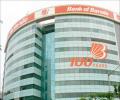
Bank of Baroda has relatively better position on impaired assets.

'Defence, capital goods, engineering, capital market-related stocks, autos, and cement sectors are my bullish bets for Samvat 2082.'
At least two public sector banks Union Bank of India and Indian Overseas Bank have quietly increased interest rates on short-term deposits to raise resources and manage asset-liability mismatch. Union Bank has announced a special deposit scheme for 400 days, which offers 9 per cent interest. The scheme was launched much before the announcement of the monetary policy. Chennai-based Indian Overseas Bank has also raised rates for large deposits.


Employees of public sector banks (PSBs) on Thursday went on two-day strike against the move to privatise public sector banks impacting normal banking operation across the country. Many branches across different parts of the country were shut as the United Forum of Bank Union (UFBU), an umbrella body of nine bank unions including All India Bank Officers' Confederation (AIBOC), All India Bank Employees Association (AIBEA) and National Organisation of Bank Workers (NOBW) had given two day strike call. As a result, services such as deposits and withdrawal at branches, cheque clearance and loan approvals might be affected due to the strike. But ATMs are expected to function as usual.
Amid stiff competition from private and foreign players, the country's 27 public sector banks logged 35 per cent growth in profit at Rs 16,546 crore (Rs 165.46 billion) while their bad assets fell below 3 per cent during 2003-04.

Jaitley said there was a need for the banking sector to fund infrastructure and manufacturing sectors to support the ambitions of higher growth.

Reliance Industries' refining earnings will remain steady, supported by its position as India's largest importer of Russian crude and favourable global supplies, according to analysts at JM Financial and Goldman Sachs. Reliance imported more Russian barrels than any other Indian refiner in the past eight months, according to data from Bloomberg/Kpler.

Anup Roy and Krishna Kant on the challenges the public sector banks face in revitalising themselves

The government has said that public sector banks have asked for much more capital than it can give.
The move comes even as Bank of India on Wednesday said its corporate clients will suffer mark-to-market losses of around Rs 125 crore. It has 34 clients with 74 derivative transactions. Last week, State Bank of India said its clients may incur MTM losses of up to Rs 700 crore at the end of March 2008.
A host of public sector banks had cut interest rates in the earlier part of this year following an advisory from Finance Minister P Chidambaram in January. Private and smaller state-owned banks, however, did not cut rates.
In a move that is likely to attract political controversy, the committee on financial sector assessment has recommended that the banking sector should be gradually opened to foreign players and that the government lower its shareholding in public sector banks below 51 per cent and allow state-owned players to merge if the Centre's stake cannot go below the prescribed lower limit.

The move to make the appointment process more robust comes after last month's arrest of S K Jain, chairman and managing director of Syndicate Bank last month, over graft charges.

The performance of banking and information technology (IT) stocks has had a significant impact on the composition of diversified mutual fund (MF) portfolios. Over the past two months, these sectors have become increasingly dominant, now constituting nearly 30 per cent of the total allocation in many diversified MF portfolios.

Banks, including country's largest lender State Bank of India, have informed the customers well in advance about the likely inconvenience due to strike.

SBI remains a favourite of most brokerages in the PSB segment.

The current employee strength of all state-run banks is about 672,000.

Amid strong opposition from CIL workers union to the proposed stake sale in the company, Finance Minister P Chidambaram has said the disinvestment proceeds of about Rs 20,000 crore (Rs 200 billion) from the coal behemoth will be invested in public sector banks.

FDI rules announced last year changed the criteria of calculating these investments and included American depository receipts, global depository receipts and convertible shares also in that category.
However, the likely impact of strike may not be much excluding few areas, said SBI.
Sensex catapults 1,241 points and Nifty vaults 382 points in two sessions in a row.

Air India is understood be in negotiations with state-run banks to avail working capital loans at low interests.

In May, MFs were the net sellers in several PSUs, as they deployed Rs 47,600 crore in equities during the month.

The minister said RBI maintains a list of non-suit filed borrowers of banks and financial institutions, while CIBIL had a database on suit-filed accounts of Rs 1 crore (Rs 10 million) and above.

In eight cases, the banks would violate the minimum public shareholding norms if their promoter, the Government of India, infused capital as announced.

Jaitley said the government had earmarked Rs 25,000 crore (Rs 250 billion) for recapitalisation.
A section of analysts feel now may not be a bad time to buy select PSBs.

Report points out corporate vulnerability indicators remain elevated.

"I'm taking a minute to respond... I do respect Raghuram Rajan as a great scholar who chose to be in the central bank in India at a time when the Indian economy was all buoyant," Sitharaman said during the lecture organised by the Deepak and Neera Raj Centre on Indian Economic Policies of the Columbia University.
